

The Next Frontier in Clean Flight?: Jet Fuel from City Waste
New Harvard-China Project research explores producing sustainable aviation fuel from municipal solid waste
AVIATION CURRENTLY CONTRIBUTES ABOUT 2.5% OF GLOBAL CARBON EMISSIONS, and with air travel demand expected to double by 2040, cutting those emissions has become a pressing priority. One promising path forward is sustainable aviation fuel (SAF), a low-carbon alternative made from feedstocks such as used cooking oil and crops. However, despite its potential, SAF currently makes up less than 1% of global jet fuel use, mainly due to high production costs and limited supply.
A new study published in Nature Sustainability points to a promising breakthrough: using municipal solid waste (MSW) as a reliable, low-emission, and cost-effective feedstock for SAF. Researchers from Tsinghua University and the Harvard-China Project on Energy, Economy, and Environment—based at the Harvard John A. Paulson School of Engineering and Applied Sciences—evaluated MSW-based SAF produced through industrial-scale gasification and Fischer–Tropsch synthesis. Their life cycle analysis found that fuel made from municipal waste could reduce greenhouse gas emissions by 80–90% compared with conventional jet fuel. The main technical hurdle, however, lies in scaling up gasification systems for widespread use.
“Unlike road transport, which is quickly shifting toward electrification, there’s no silver-bullet solution for achieving carbon-neutral aviation,” says Dr. Jingran Zhang, the study’s first author and a postdoctoral fellow at the Harvard-China Project who is supported by the Salata Institute for Climate and Sustainability at Harvard University. “Turning everyday trash into jet fuel could be an innovative but major near-term step toward cleaner aviation. By converting municipal waste into low-carbon fuel that already works in today’s engines, we can start cutting emissions immediately, without waiting for future technology.”
"Turning everyday trash into jet fuel could be an innovative but major near-term step toward cleaner aviation.” - Dr. Jingran Zhang
MSW as a Promising Feedstock
MSW includes everyday garbage, including both biogenic materials (organic matter like food scraps and paper) and non-biogenic ones (like plastics and metals). Traditionally, much of this waste has been landfilled or incinerated, practices that consume land or can contribute to air pollution. As landfill space shrinks and waste generation rises, converting MSW into liquid fuel like sustainable aviation fuel could solve multiple problems: reducing waste, conserving land, cutting emissions, and producing cleaner energy to help cities move toward zero-waste goals.
This study explores the largely under-researched potential of MSW-based SAF using real-world data using gasification-Fischer-Tropsch (FT) technology. The researchers analyzed key emission sources, calculated greenhouse gas impacts, and identified ways to boost efficiency. They found that while MSW-SAF significantly lowers emissions, only about 33% of input carbon is converted into fuel due to gas composition mismatches. Efficiency could be improved by capturing CO₂ or adding green hydrogen (produced with renewable power) during processing.
Global Implications of MSW-SAF in Aviation Fuel Supply
Many countries are ramping up efforts to make aviation more sustainable by adopting cleaner fuels. In the United States, the government aims to produce up to 35 billion gallons of SAF annually by 2050, supported by strong financial incentives. In the European Union, new regulations will require all departing flights to gradually increase their share of SAF, catapulting from 2% in 2025 to 70% by 2050. On a global scale, the International Civil Aviation Organization’s CORSIA program requires operators to offset emissions growth, which they can do by buying eligible offsets or by using SAF, thereby encouraging SAF uptake.
This study examined how MSW could be converted into SAF under several scenarios. In the most practical case, global MSW could yield around 50 million tons (62 billion liters) of jet fuel globally, cutting aviation’s greenhouse gas emissions by roughly 16%. If waste management and conversion systems are inefficient, the benefits drop substantially. However, if green hydrogen is integrated into the process, production could reach 80 million tons per year, which is enough to supply up to 28% of global jet fuel demand and reduce emissions by as much as 270 million tons of CO₂ annually.
In Europe, the projected MSW-SAF output would already exceed the EU’s fuel-blending targets while remaining compliant with sustainability standards. Economically, the study suggests that adopting MSW-based SAF could save airlines money under carbon pricing systems like CORSIA, particularly when government incentives and subsidies are factored in.
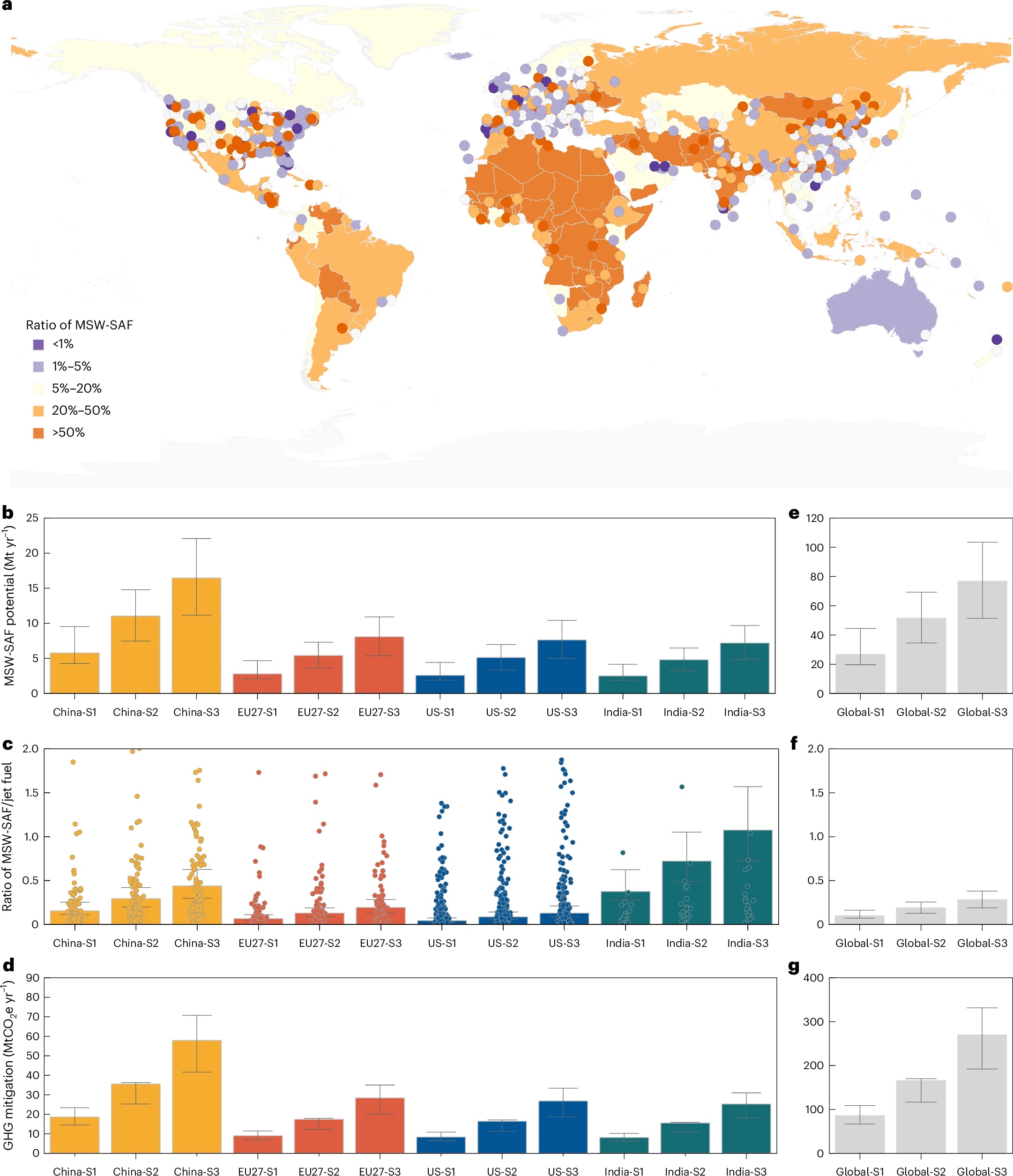
Ultimately, sustainable aviation fuel (SAF) currently makes up less than 1% of global jet fuel use, mainly because of its high production costs. This underscores the urgent need for strong policy action and financial incentives to scale up supply. The study finds that when technological progress is slow, subsidies are critical to bridging the cost gap; without them, SAF remains economically unviable. The impact of such support is already evident in the United States, where SAF production more than doubled in 2023, driven by federal and state incentives that currently remain in place.
“This study presents a blueprint for converting urban waste into sustainable aviation fuel, offering future environmental and economic benefits,” summarizes lead author Michael B. McElroy, Gilbert Butler Professor of Environmental Studies at Harvard University and chair of the Harvard-China Project on Energy, Economy, and Environment. “Moving forward, broad collaboration among governments, fuel producers, airlines, and aircraft manufacturers will be essential to increase production, lower costs, and accelerate aviation’s path to net-zero emissions.”
Research Cited: Jingran Zhang, Fang Wang, Zhao Jia Ting, Weiguo Dong, Shaojun Zhang, Ye Wu, Chris P. Nielsen, Ming Zhao, Jiming Hao, and Michael B. McElroy. 2025. “Powering Air Travel With Jet Fuel Derived from Municipal Solid Waste ”. Nature Sustainability. Publisher's Version